All Posts By

Stacey

Live, Work

What a difference a year makes

It’s been 12 months since I left my job at a consulting firm. My plan was to take a break for a year and think about what I wanted next. Well, that was as much of a plan as I had! And like all best laid plans, things didn’t quite go that way, but I’m very happy with the outcome!

In the weeks leading up to the end of 2023, I tried to gently recover from the loss of my dad and navigated that ‘difficult first Christmas’. Then at the end of January, we packed the car (including the dog) and drove 1400 miles to Southern Spain – and stayed until Easter!

The warm Andalucian spring was balm to the soul – and what a joy to live somewhere else for a while – be someone else – and redevelop my curiosity – for new places, new routines, new experiences. Even the food shop felt like a brand new adventure! (100% recommend, will do again).

Refreshed, still unsure about work, I spent a few months at home as well as taking a few trips. I went to the theatre on my own (Plaza Suite – brilliant!), saw some art, joined a gym (and kept going) and fitted in a few days in Mallorca and a week in Greece. And while I was lying on a lounger in Kefalonia, I (with Madge, obvs) decided to start not 1, but 2 businesses!

So fast forward, here we are. I’m back in Spain (just a week this time), sitting here as co-founder of 𝗕𝗲𝗮𝘂𝘁𝗶𝗳𝘂𝗹 𝗙𝘂𝘁𝘂𝗿𝗲𝘀, a micro design-led consultancy that works with clients to change the way services, experiences and products 𝘵𝘩𝘢𝘵 𝘮𝘢𝘵𝘵𝘦𝘳 are made and sold.

And as co-founder of 𝗕𝗶𝗴 𝗦𝘁𝗼𝗿𝗶𝗲𝘀, a sustainable t-shirt brand. A fun journey that began with a simple idea: to create t-shirts that we would genuinely love to wear – with designs that are inspired by the passions that fuel us.

I hadn’t planned on either of those things a year ago, but the space to let ideas emerge made me realise I don’t have to define myself by any one thing. I knew I wanted to do many, different things.

Which is why when I was also asked to take a fractional role as a co-Head of Creative at a personal finance management software brand I leapt at the chance. A position with a focus on elevating creative output, smooth running ops, AI-powered growth and developing high performing teams – yes please! I’m just back from California meeting the team and delivering a session on AI in Marketing – and excited about the next few months of making a difference.

What have I learned in the last year?

  • 𝗥𝗲𝘀𝗶𝗹𝗶𝗲𝗻𝗰𝗲 𝗶𝗻 𝘂𝗻𝗰𝗲𝗿𝘁𝗮𝗶𝗻𝘁𝘆: Embracing uncertainty has led to unexpected growth in unexpected areas (sit in the liminal space – even if it’s uncomfortable!)
  • 𝗧𝗵𝗲 𝘃𝗮𝗹𝘂𝗲 𝗼𝗳 𝗿𝗲𝗳𝗹𝗲𝗰𝘁𝗶𝗼𝗻: Time to reflect on what truly matters sparked new ideas – not just about work, about everything
  • 𝗜 𝗳𝗼𝘂𝗻𝗱 𝗺𝘆 𝘁𝗿𝗶𝗯𝗲: True friends (and good colleagues) shone through during tough times; I cherish them
  • 𝗔𝗱𝗮𝗽𝘁𝗮𝗯𝗶𝗹𝗶𝘁𝘆 𝗶𝘀 𝗸𝗲𝘆: Being open to change and new experiences is exciting – trust yourself, you’ve got the experience and the smarts
  • 𝗦𝘁𝗿𝗲𝗻𝗴𝘁𝗵 𝗶𝗻 𝗰𝗼-𝗹𝗲𝗮𝗱𝗲𝗿𝘀𝗵𝗶𝗽: Partnering exposes the power of diverse perspectives and collaboration – embrace the balance!
  • 𝗠𝗼𝘃𝗲 𝘆𝗼𝘂𝗿 𝗯𝗼𝗱𝘆: Keeping active clears my mind and boosts my mood – it’s now a forever part of my lifestyle

To new adventures – and everyone who has helped me on this one 🎉

Design, Travel

SFMOMA

A flying visit to San Francisco on my way to Monterey on business – and SFMOMA was top of my list of places to visit. It didn’t disappoint.

I took myself off on Saturday morning, while it was still relatively quiet – and on the advice of a friend, covered the whole gallery from top to bottom. It’s almost impossible to pull out everything I loved, but here are some highlights.

Jenny Holzer, 1983: Truisms

Artwork showing yellow triangle and black block

Ellsworth Kelly, 1993: Yellow Relief with Black

Image of a colour spectrum

Ellsworth Kelly, 1953: Spectrum 1

Artwork of four squares with squares nested inside

Josef Albers, 1954: Homage to the Square

Immersive experience

Yayoi Kusama: Infinite Love

Installation of yellow and black abstract pumpkins

Yayoi Kusama: Aspiring to Pumpkin’s Love, the Love in My Heart

For Yayoi Kusama, pumpkins have been a lifelong source of fascination. She was first drawn to them in childhood, citing their “generous unpretentiousness” and “spiritual balance,” and has explored them continually in her painting, sculpture, installation art, and poetry.

Artwork called 256 Colours by Gerhard Richter

Gerhard Richter, 1974: 256 Farben.

Blue and purple immersive tunnel

And lastly, this amazing immersive glass tunnel…I didn’t note the artist, but I loved it!

There were so many, many more pieces I loved. This is just a selection of the great work on display.

Live

Remember to smile at a stranger, and their dog

I was so sad this week to read that @CherryMorello had passed away. I didn’t know her – she’s someone I have followed on Twitter for a long time, and she was living with Stage 4 bowel cancer. Her posts were so honest as she shared her experiences with humour and candour, even up to her last few messages.

The saying ‘Remember to smile at a stranger, and their dog’ is hers. It’s something she often ended her message threads with, and I always thought it was such a lovely sentiment.

Earlier in the week I was having a chat with someone who told me that their new year resolution was to smile at people they walked past. And stop for a chat if it felt right to do so. Isn’t that lovely?  I’ve realised in recent months how important those tiny moments can be – and how, while they can start small, before you know it you are chatting properly with the people you see regularly. Having a cute dog definitely helps with that!

Picture of a Beagle dog looking directly at the camera

It’s well documented that social isolation and loneliness can have a profound negative effect on our mental and physical health, and those micro interactions – a friendly smile, a small chat, or a shared moment – really help our sense of connection in everyday life. While it’s very important to acknowledge they are two different things, isolation and loneliness can also be linked. A recent report in Fortune magazine stated that ‘Social isolation is linked to a 50% increased risk of dementia and an increased risk of other chronic conditions, according to the U.S. Centers for Disease Control and Prevention. One study found the health consequences of loneliness are on par with smoking up to 15 cigarettes a day.’ Those are mindblowing stats, that obviously have a massive effect on healthcare and other services. It’s a challenge I’d love to be part of tackling as a service designer.

So, for now, while it may only be a small thing, I am going to take a leaf out of @CherryMorello’s book, and smile at a stranger (and their dog) just a bit more. You never know the difference it might make to someone’s day.

There’s is a helpful list of loneliness resources on the Mind website, and charities like AgeUK – who run brilliant friendship services that help lonely older people – are always looking for volunteers. And let me know if you start smiling at strangers too 😀.

Live

The future is not a destination, it’s a direction

Sunrise on the beach in Marbella, Spain.

Hey there, wanderers, adventurers and daydreamers! Happy New Year.

First up, I can’t claim that headline, it belongs to the very brilliant Ed Catmull. But it sums up perfectly where I am right now, with my life in a radically different place to this time last year (or ever before, really), and as I focus back in on capturing my thoughts here. This tiny blog isn’t brand spanking new – it’s been here, seen things, but it is ready for a fresh start.

Now, I know what you’re thinking – Blogging? In 2024? But bear with me just a sec; this isn’t a nostalgia trip. 2023 shook my world up in various ways, and I’m entering the new year job-free. A conscious and deliberate choice to see what what it feels like to think about – and travel in – a different direction and swim in different waters. So I think of this more as a scrapbook-style journal; bits and pieces collected as I go along – a personalised compilation of memories, experiences and mementos captured in a corner of the internet where I spill the beans on all things travel, design, work, life, and everything in between. An attempt at embracing the timeless art of storytelling – or at minimum, somewhere to look back on in the future to see how far I’ve come. And I’m rubbish at keeping a paper journal, so.

In my work life I’ve been running projects, leading teams and advising clients for three decades. I’ve had a fabulous career (so far) that has seen me dance through the home entertainment industry, create, market and transform global brands and drive digital transformation, customer experience and human-centred design across a range of sectors. In 2002 I founded and ran my own design agency and most recently I led Customer Experience for banking clients in a consulting practice. From the record industry to the Bank of England – talk about a varied journey!

In recent years I’ve been lucky to do what I love the most – combine my multi-industry knowledge with insight and expertise in digital, design and technology to enable organisations to reimagine services and experiences, develop and manage their digital products, and create capabilities that help them grow, profitability.

But enough of that. This blog has some work stuff on it, but is more about the personal than the professional. You can head over to LinkedIn if it’s the work-me you want to find out more about. Here, each post is a page in my digital diary, filled with the highs and lows, the places that stole my heart, the designs that made sit up and look, random musings, plenty of cocktails and the personal and work experiences that taught me the most. I like talented people, beautifully useful things and stuff that makes the world a better place, so expect a fair bit of that.

So, come wander with me and join me on this journey.

Design

Eastbourne hosts the Turner Prize

When I heard the Turner Prize was being exhibited and hosted in Sussex, it definitely made it onto my ‘must-see’ list for this Autumn.

The Turner Prize is probably the world’s best known art event, and is awarded to a British contemporary artist for either an outstanding exhibit or other presentation of work in the past 12 months. Previous winners include Grayson Perry, Rachel Whiteread, Anish Kapoor and Damien Hurst.

So on a wet and windy Thursday, we set off for Eastbourne to visit the exhibit at the Towner Gallery. I wasn’t really sure what to expect…

There are 4 shortlisted artists – and the award ceremony is being held on 5 December. The whole exhibition was free to enter, and it was great to see the amount of accessible and inclusive tools and resources available to ensure the widest audience possible could enjoy the art.


The first set of exhibits were by Ghislaine Leung, who focuses on the conditions of art production, its presentation and circulation. As I understood it, Leung creates text-based instructions/descriptions that are then executed by the gallery team. And so this execution obviously changes with every team that realises it. It’s interesting conceptually, and I quite like the idea that the piece changes with every interpretation and every context, but, I guess, at a basic level, some pipes and a water fountain just wasn’t that understandable – and even less so if you hadn’t read the descriptions or watched the video.

Rory Pilgrim uses song writing, film, texts, drawings, paintings and live performance in his work – challenging the nature of how we come together, speak, listen and achieve social change. His film, RAFTS was made during the pandemic – a raft keeping us afloat in challenging or dangerous times.

We didn’t get to see the whole film, as there were specific screening times, so we only ducked into about 10 mins worth, unfortunately. The film is narrated by residents of Barking and Dagenham from Green Shoes Arts and includes singers and members of Barking and Dagenham Youth Dance. It really felt like this had been made in and with the community and took contributions from a wide and diverse set of people. While it was definitely interesting and I would love to have seen more, it felt like something I might watch on TV, rather than a piece of award-winning art. But what do I know, I’ll probably be totally surprised by the time the entries are judged.

The absolute stand out of the show for me, was the exhibit by Barbara Walker. And not just this show – it’s one of the best exhibitions I’ve seen. I’m still thinking about it now.

In Burden of Proof, Walker directs our focus towards the individuals, families and communities whose lives have been touched by the Windrush scandal. The work shows really impactful large-scale charcoal figures intricately sketched directly onto the gallery wall, accompanied by a compelling series of surrounding images. Through monochrome portraits, Walker layers poignant images of those affected by the scandal over meticulously hand-drawn reproductions of documents that underscore their right to remain in the UK.

This thought-provoking display really encouraged me to contemplate on the genuine repercussions of these political decisions. This work stands as a powerful exploration of the human stories that sit behind (and are directly impacted by) bureaucratic cruelty – and you get a real sense that the people were forgotten as the documentation became the important thing.

The wall drawings will be washed away at the end of the exhibition, to signify erasure and disappearance.

And lastly, I was excited for Jesse Darling’s entry, which promised ‘an installation that explores borders, bodies, nationhood and exclusion’. Unfortunately I didn’t like it. I guess crash barriers, barbed wire and net curtains do that – but it all felt a bit clichéd to me. There didn’t seem to be any fresh or new thinking around that theme…but hey, that’s just to my untrained eyes.

So, while two were a definite ‘no’ for me, if you go along just to see Barbara Walker’s Burden of Proof it won’t be a wasted visit. And there’s a public art trail and other events in the town worth sticking around for.

Turner Prize – 28 September 2023 to 14 April 2024 (free admission).

Design

REBEL at the Design Museum

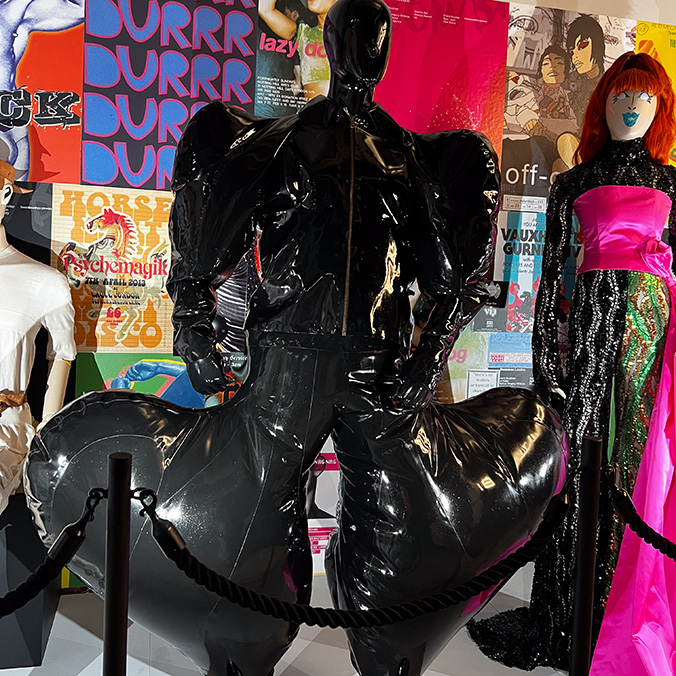
Went to see this fashion exhibition at The Design Museum, which is in collaboration with the British Fashion Council (BFC) and celebrates the 30th anniversary of the BFC’s NEWGEN programme. The show, sponsored by Alexander McQueen, focuses on the work in the early careers of design talent that has been supported by the programme.

Loved this Giles Deacon suit.

Highlights include the swan dress controversially worn by Björk at the 2001 Oscars, Harry Styles’ Steven Stokey Daley outfit from his video for ‘Golden’, and Sam Smith’s inflatable latex suit by HARRI from this year’s BRIT Awards. Collections and work by JW Anderson, Wales Bonner, Erdem, Molly Goddard, Christopher Kane, Simone Rocha, Russell Sage, and many more.


And this ear cuff was extraordinary.

The show is great, and is on until 11 February 2024. Go see.

Eat, Live, Play

House Classic: The Kentucky Manhattan

I’m a late comer to this cocktail – call it a lockdown revelation, but it’s currently my favourite tipple. Strong, warm and silky – the Manhattan is one of the dark spirit cocktails that effortlessly crosses the seasons.

Originating in…of course… Manhattan, sometime in the mid-late 1800’s, the original Manhattan was a mix of  “American Whiskey, Italian Vermouth, and Angostura bitters”, and I guess my house classic doesn’t veer too far away from these original roots.

Glassware

I like to serve a Manhattan in coupe, a shallow, saucer shaped stemmed glass. My current favourite is the Riedel Bar Crystal Glass Nick & Nora set. At 140ml, they are slightly too small for the recipe below, but it means you can leave some in the cocktail shaker chilling while you drink the first glass.

I always put the glass in the freezer for 10 minutes before making the cocktail.

Ingredients

I’ve tried different variations of Bourbon, Rye and Vermouth brands, but this one comes out on top for me. The Starlino is an Italian sweet Vermouth di Torino, aged in Kentucky bourbon barrels. It includes wormwood, cloves, vanilla, rhubarb, ginger, cinchona tincture, grape skin, raisins, bitter orange peel and other herbs and spices, and unlike some Vermouth, is not too bitter, so it balances well with the Kentucky-originating Jack.

Recipe

  1. Take one round, golf-ball-sized ice cube and place in cocktail shaker (square ice cubes are also fine – but bigger the better)
  2. Add the spirits and the bitters (you could also add cherry bitter here if you like)
  3. Stir until it’s nicely chilled
  4. Pour, either straight up or with the single ice cube, into a cocktail glass and garnish with a maraschino cherry and a tiny drizzle of cherry juice.

Sip and enjoy with a snack.


Work

Financial Literacy: The New Frontier of Banking CX

Why Financial Literacy Is the New Frontier of the Banking Customer Experience


Money is awash in the market, so why are so many consumers so financially unhealthy?

Despite the proliferation of financial services, platforms and tools in the marketplace, consumers are more vulnerable than ever. In the U.S., a Federal Reserve survey finds that 36 per cent of consumers can’t cover an unexpected $400 expense with cash or its equivalent. Meanwhile, nearly a quarter say their finances are worse due to job layoffs and other issues caused by the pandemic.

European consumers are experiencing similar issues. Some 48 per cent of residents report that their wellbeing declined in 2020 due to COVID-19, and one in five say they are going into debt to cover everyday spending.

As governmental help in the form of rent subsidies, mortgage payment holidays and enhanced unemployment ends around the world, consumers are at greater risk than ever. And they want help: In the UK, 93 per cent of consumers say that education has failed to prepare them to handle their finances, and 43 per cent believe that it’s their bank’s responsibility to do so.

Consumers are constantly making choices that improve or harm their finances, and many have long-term consequences. For example, taking on excessive debt can lead to high interest rates, crisis-based living and bankruptcy. Failing to save anything for retirement, as 45 per cent of U.S. boomers have, is now plunging the elderly into poverty with alarming regularity.

Adding to the complexity of the challenge is that self-serve financial tools, seamless digital switching and easy lending terms make it easier than ever for consumers to get credit and loans or gamify services they know little about – and they have. Recently, Robinhood made an undisclosed settlement to the family of Alex Kearns, the 20-year-old novice options trader who committed suicide when faced with suspected losses of $730,000. This story should serve as a chilling case in point that institutions share the risk of financial literacy issues with their consumers.

Banks can make more money from servicing wealth, not debt 

For banks, financial literacy is a challenge that can and should be faced head-on. While banks have historically made their money by servicing debt, low and sustained low interest rates have cannibalised that source of revenue. Now, banks make more money by helping consumers grow their wealth. Given that huge swaths of the population around the world are living in financial peril, banks’ current and future revenues and profitability are also at risk. So, what can banks do to help consumers learn about – and master – their finances?

Why investing in financial literacy is in banks’ best interests

Delivering an exceptional customer experience is no longer just about offering great products and services; it’s about helping consumers navigate the choices, small to large, that affect their financial well-being and mental health.

When banks assume a role as educator and mentor, they can help consumers reduce and eliminate debt and manage their ongoing commitments, such as mortgages and loans. They also help consumers increase their wealth over time. Banks win by deepening customer relationships and increasing profitability while reducing bad debt and collections costs and freeing up funds for ongoing digital investment.

Here’s how banks can help consumers improve their financial well-being now:

Learn from the competition:

Fintechs have driven innovation in the industry, with simple, user-friendly interfaces; user tools such as AI-driven chatbots; and insights such as nudges, alerts, spending breakdowns and data visualisations. These tools can be applied across services, including cash management, payments, lending, insurance and more. Banks can either replicate these features or buy tools from fintechs directly.

Nudges and alerts can help consumers monitor such items as outstanding balances, loan payment terms and due dates, and more, improving their credit and helping them reduce debt. Modelling tools can help explore the implications of decisions, helping consumers better experience their consequences.

In the U.S., Zoggo Finance is teaching Gen Z how to make better decisions, using games and incentives. Emma helps consumers track finances, eliminate wasteful subscriptions and use recommendations to save money. Betterment and Wealthfront provide robo-advising that simplifies investment decision making, while Coinbase makes cryptocurrency investing accessible.

Develop deep customer insights:

Banks can learn how consumers make decisions, including those that aren’t in the best interests of their financial well-being. Teams can conduct qualitative and quantitative research and apply design thinking to these challenges.

Teams can conduct innovation sprints, using insight-driven tools and techniques such as user personas, pain mapping, inspirational case studies and new technologies to explore new opportunities. They can then align the best of these opportunities to their target customer experience, by developing a growth strategy; commercialising new business models, products and services; and aligning their technology roadmap and investments accordingly.

During the early days of COVID-19, Sparkler executed fast-paced research to learn how UK consumer beliefs and attitudes were changing. As an example, Sparkler found that among 18- to 34-year-olds, 37 per cent needed more credit to pay for essentials, 45 per cent were interested in alternative ways to invest money and 38 per cent said they needed greater guidance on managing pensions, insights banks could put to work.

Become a data-driven business:

Banks can improve data gathering, analysis and segmentation across the customer lifecycle. They can then use this data to design personalised customer journeys across digital channels, where financial education is delivered both just-in-time and on an ongoing basis. By deploying cloud-based tools to better predict behaviour and risk, they can offer financial content and intervention to support customers’ decision making.

Banks can use AI-driven chat and other tools to guide consumers through products and services and help them make the right choices. Similarly, brokerages can break down and demystify options, stock and crypto trading, while putting appropriate checks and balances in place to avoid harming vulnerable consumers.

Ageas, a leading insurance company in Europe and Asia, is building analytics solutions at scale, to offer personalised services and automated processes across its life, non-life, and accident and health business lines.

Deploy modern strategies and architectures:

Banks are moving data to the cloud, using microservices to build flexible services, and creating end-to-end solutions using APIs. By so doing, bank teams can gain access to near-real-time, accurate data for decision making. They can then use advanced analytics to predict financial difficulty, model the affordability of new loans and automatically trigger interventions for vulnerable consumers.

But they’ll have to move faster to keep pace with the market. Banks are adopting agile ways of working to speed up innovation and reduce risk. Schroders, a global investment manager, has trained 600 professionals on agile processes, accelerating the speed of project release by 20 per cent in just nine months.

As consumers struggle with finances, they are looking for a helping hand. By intervening early and often with personalised financial literacy tools and services, banks can create customers for life. As financial services leaders know, keeping, servicing and growing customer relationships can be more profitable than constantly marketing for and losing them, or writing off bad debt due to ongoing loan and credit losses.


This article was first published in Global Banking & Finance Review 

Work

Digitally enabled, customer-centred approaches in banking

Human problems, personal solutions: digitally enabled, customer-centred approaches in banking

The UK faces a looming crisis in personal debt. Even before COVID-19, the Money Advice Service, an independent organisation set up by government estimated that 8.3 million people in the UK were over-indebted. 10 months after the first lockdown in March 2020, 14 million Britons experienced a direct negative impact on their income, 4.3 million fell into arrears with utilities, council tax or rent and 2.8 million used high-cost credit to make ends meet.

The UK Government’s Debt Respite Scheme (Breathing Space) will help many, however as furlough schemes approach their end and mortgage payment holidays begin to expire, many borrowers face a potential cliff edge. The scale of the problem could be huge; press reports suggest that over 4.7 million payment deferrals have been granted for UK mortgages, personal loans or credit cards.

Vulnerable customers are particularly susceptible to harm from debt. Key drivers of vulnerability often overlap and can include negative life events, deprivation, low financial resilience and ill health. Vulnerability also correlates strongly with mental health problems. Our analysis shows that vulnerable customers are not simply a small minority of sub-prime borrowers. They number in the millions and include the temporarily vulnerable, such as individuals or families affected by unexpected economic shocks like illness or job loss.

The expectation-reality gap

These potential challenges create an opportunity for lenders to build on the goodwill generated during the pandemic by treating vulnerable customers fairly, constructively and with empathy. At the same time, lenders need to ensure they meet much tougher regulatory requirements than in previous credit downturns. The FCA’s emergency COVID-19 regulations include an increased focus on vulnerability, and new guidance requires firms to actively manage persistent debtors and prove that vulnerable customers are treated fairly.

Unfortunately, there is often a gap between these expectations and lenders’ available responses to distressed customers’ common pain points. Typically, interventions are blunt instruments that treat the symptoms of excessive debt without curing the underlying causes. They rarely consider customers’ financial understanding, mental health or wider circumstances. And all too often they push customers towards phone-based interactions. This not only increases costs but makes it hard to provide seamless service, due to a lack of joined up systems. Phone conversations also can impede effective engagement, since they expose many vulnerable customers to feelings of embarrassment, awkwardness or harassment.

Delivering better outcomes for customers and lenders

To close these gaps, lenders need to move fast to develop customer-centred responses that allow them to gather customer information faster, analyse risks and behaviour more effectively and intervene earlier. The ultimate goal should be to engage effectively and proactively with vulnerable customers, achieving better outcomes for customers and lenders alike.

To deliver this standard of service, lenders need to combine a human-centred design approach backed up by a digitally-enabled operational spine. Accelerating customers’ ability to use modern data-enabled digital services will help lenders to deliver customisable, timely and flexible interactions. That will encourage greater self-service by customers, taking pressure off contact centres and ensuring that – when they do take place – personal interactions are valuable to both parties.

Such an approach is not without its obstacles, especially for established lenders reliant on legacy technology or with customer information divided between databases and organisational silos. These barriers, together with over-reliance on manual processes, can make it hard to provide seamless experiences – let alone tailored, insightful interactions.

To overcome these hurdles, lenders should follow five key patterns for success:

  • Leading by design: Applying design thinking to business strategy can help bring customer-centric products and processes to market quickly. Developing a clear user-centred North Star based on target customer experiences will align technology, data and operations, creating value for customers, lenders and staff.
  • Transitioning technology: Overcoming the limitations of legacy technology infrastructure, for example by replicating data to the cloud and using new microservices, will help lenders to innovate quickly and easily. Integrated technology allows vulnerable customers to build relationships with individual staff over multiple interactions, ensuring fair treatment and making specialist support readily available.
  • Being a data-driven business: Creating modern data strategies and architectures is critical to digital improvement. Providing ubiquitous access to actionable data in-house and to approved partners is the goal. Reliable, timely and machine-readable data allows lenders to use advanced analytics to predict financial difficulty, model affordability and trigger interventions for vulnerable customers.
  • Embracing the platform opportunity: Developing platforms that can be integrated into broader value chains will mean lenders can deliver whole ecosystems to customers. The ability to quickly share data across the organisation and beyond will allow firms to offer tailored interventions when and where they’re needed, significantly improving how vulnerable customers access assistance.
  • Using automation for advantage: Using robotics, the cloud and the Internet of Things will make processes and experiences faster and more efficient. Building flexible multi-component solutions can be more valuable than end-to-end automation. For example, integrating chatbots into experiences can automate the initial steps of all journeys, but with manual interactions available on request.

Identifying and designing target customer experiences is a key enabler of these patterns of success. Focusing on prioritised elements of target experiences makes it easy for organisations to make progress at pace, improving incrementally rather than investing heavily in ‘big bang’ transformations that take a long time to make a difference to customer experiences.

Furthermore, improving customer experiences quickly will also deliver early, tangible returns on lenders’ investments all the while delighting their customers. Better experiences allow lenders to reduce operational demands, lower customer contact costs, reduce the costs of sales and reduce staff turnover – all of which strengthen financial performance. Our experience shows that a one per cent improvement in customer satisfaction is typically matched by a five per cent reduction in operating costs.

Integrating user-centred design with modern digital engineering holds the key to lenders’ ability to achieve strong alignment between vision, implementation and returns on investment. In turn, that will ensure not only vulnerable customers are treated fairly, but that lenders optimise their own performance and affirm their role in society.

Originally posted on paconsulting.com.